AI Conversations: A Two-Lane Approach to Assessment
This article is part of an ongoing series exploring how LCS is integrating artificial intelligence into learning. From innovative tools to ethical discussions, we offer a transparent look at AI's role in authentic, personalized education.
The intersection of AI and education continues to raise questions about learning, thinking, and assessment. At Lakefield, we've been asking: What kind of learning do we want to protect and what kind do we want to enhance? Our answer has taken shape in what we call the Two-Lane Approach—a clear, thoughtful stance on AI in assessments grounded in research and aligned with our values.
Over the past year, a working group of faculty, administrators, IT staff, and school leaders engaged in research around best practices for AI in education. The approach that resonated most strongly came from the University of Sydney, offering a model that prioritizes trust, transparency, and challenge as opposed to models that relied on detection and punishment.
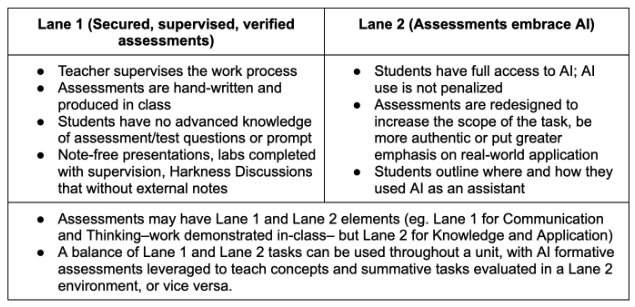
What makes this approach distinctive is its clarity. Lane 1 assessments are secured, supervised, and AI-free—written by hand, completed in-class, and designed to capture independent thinking. Lane 2 assessments are designed with AI integration in mind—where students are encouraged to use AI tools, reflect on their process, and extend their learning through technology. This framework doesn't just clarify expectations—it promotes better conversations about when AI enhances learning and when traditional approaches offer deeper growth.
Across subject areas, the Two-Lane Approach has expanded creative possibilities. In humanities, students use AI to explore complex issues before teaching peers without notes or slides, translating knowledge into their own voice. Math students construct equations that produce art in the style of Sol LeWitt—working through math by hand in Lane 1, then using AI to visualize and refine their work. The assignment culminates in students reflecting on their ability to communicate mathematical ideas clearly and assessing the spatial capabilities of AI tools. Creative writing students experiment with genres they've never attempted, producing sophisticated, real-world products like novels, plays and marketing campaigns. Lane 2 tasks expect that students will use AI, so the expectations for the final product are amplified. Rather than write a poem, students write an anthology. Rather than write a short story, they produce a novel.
Student feedback confirms they value this transparency. They appreciate knowing exactly when AI use is expected—and when it isn't. As one student reflected, 'I really like Flint because it's very specific about the advice it gave without changing the paragraph itself,' highlighting how clear parameters help students maintain ownership of their work. This approach maintains the essential "friction"—the cognitive challenge and critical thinking required for deep academic growth—while leveraging tools that provide responsive feedback.
The real test of this approach isn't in our policy documents - it's in daily classroom moments when students have autonomy to choose how to approach a problem. We're encouraged by how often they're making thoughtful choices, not just convenient ones.