AI in Action: How Lakefield Students Are Solving Real Problems
This article is part of an ongoing series exploring how Lakefield College School is integrating artificial intelligence into learning. From classroom use to student-led projects, we want to offer a clear look at how AI is becoming part of authentic learning at LCS.
In the AI Club this year, Lakefield College School students have been building tools to solve problems within the school community—from apps that help sort mail in the mail room, to tools supporting students with dyslexia, to systems that help us engage with LCS’s historical artifacts.
Our students identify needs around them and build small, useful tools with the help of AI coding platforms like Claude Code. They design apps and extensions that offer practical solutions to real problems. Students in AI Club make daily life at Lakefield more efficient and more accessible by answering the question, “what problems can we solve for ourselves and for the school community?"
For Daniel Li ’26, that question is the starting point for leveraging AI in useful ways. As the Senior-In-Charge (SIC) of the AI Club, Daniel describes the club as “a space where students can explore what AI can do and keep up with what’s new.” He sees LCS as a school that has chosen to engage seriously with AI.
“I’m really grateful that our school is willing to explore AI,” he said. “Some schools are pushing it away, but here we have access to tools that actually help us build things.”
Daniel's first major project came from a familiar boarding school problem. Students in residence had no way to know whether a laundry machine was free, who was using it, or when a load would finish. He built a reservation app so students could book time and see machine status in real time. "I noticed there was an existing problem in our residence," he explained. "The laundry was always busy, and you didn't know whose clothes were in the machine. I felt like there was something that needed to be fixed."
That project changed Daniel’s perspective. “During the process, I learned a lot, and I helped people. It felt like an all-win situation.” Once he saw that he could build something useful, he began noticing other problems. “After I finished that project, I thought, this is so useful. I created something I never thought possible.”
Daniel’s next project came from a faculty need. Ms. Nichols, the Program Area Leader for Math and Computer Science, identified a common frustration for teachers using large language models to create math or science materials. When formulas are generated in tools like ChatGPT, Gemini, or Claude, they do not copy neatly into Google Docs. Equations become garbled and teachers have to fix what should have saved them time.
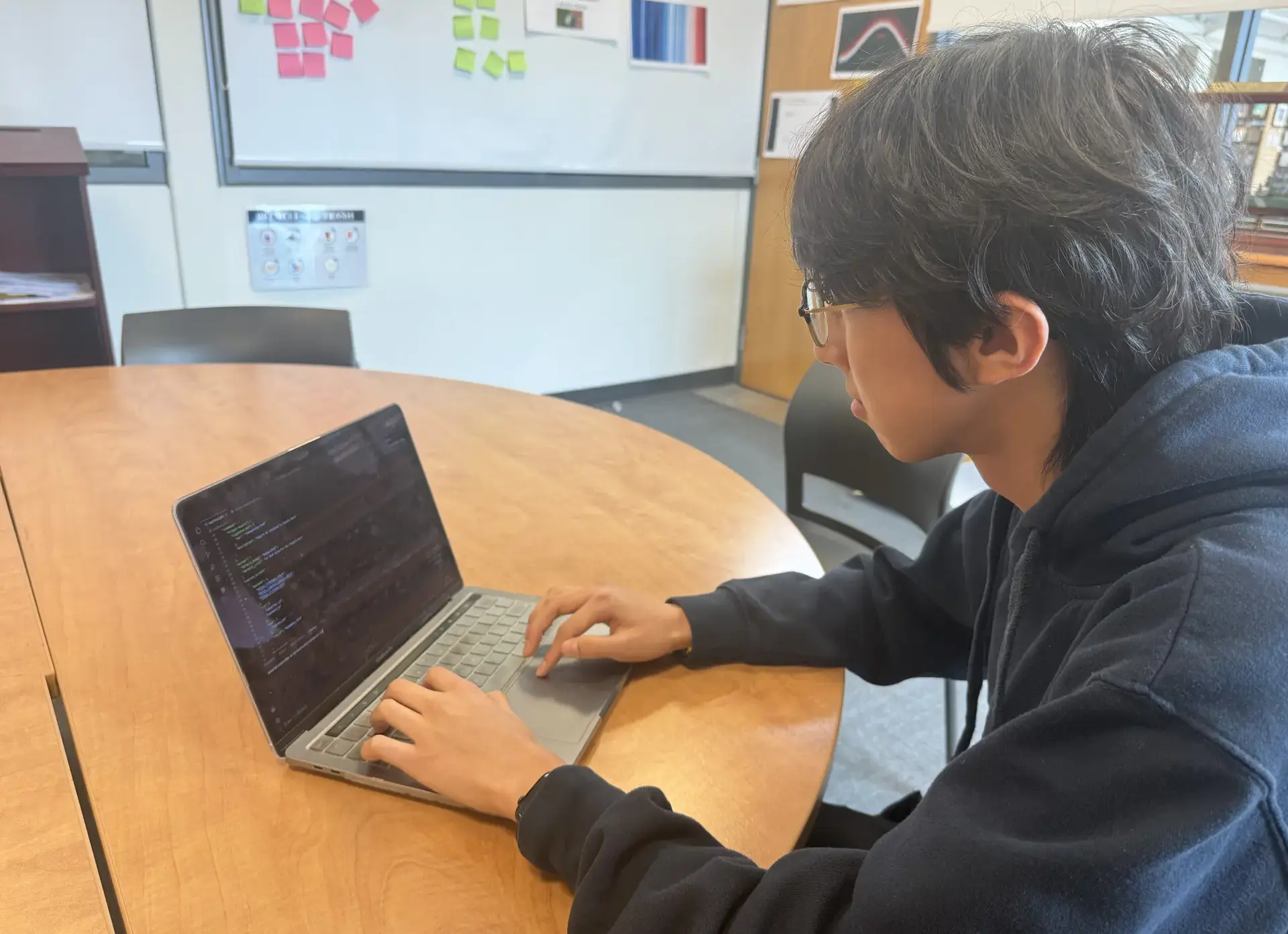
Daniel began building a Chrome extension that allows users to export formulas cleanly from an AI response into a Google Doc. He has continued to upgrade this tool to add capacity and functionality. The extension can now support chemical equations, images, charts, and longer conversations where teachers may want to choose which response to export.
The first version took him about ten hours to build. It was not simply a matter of asking AI to create the tool. Daniel had to describe the problem, test how different models format math, identify why the formulas were breaking, and work through several versions of the interface.
“Every language model has a different way of outputting math equations,” he explained. “I had to identify the format, test what worked, and then keep improving it.”
This is the kind of AI learning we are most interested in at Lakefield College School — students using AI critically and creatively to extend what they are capable of.
The tool is not replacing Daniel’s thinking; AI has become a partner in his process, but Daniel still has to define the problem, judge the output, test the result, and revise the design when it does not work. He is learning to think like a developer because he has learned to see problems as solvable.
“I think I notice problems more now,” he reflected. “Before, I might think, there isn’t a solution, so I’ll just go to someone else. Now I think, there must be a solution, and I can solve it with the help of AI.”
Daniel’s work is one example of a broader shift taking place in the AI Club. Students are moving beyond exploration to application, using AI in ways that have tangible impact on their community.
Next year, Daniel will study commerce at the University of Toronto’s Rotman School of Management, where he hopes to explore the connection between business, finance, and AI. “I want to study business as my main focus and AI alongside it,” he said. “I’m interested in the intersection between business, finance, and AI, and how AI can assist the way business works.”
Daniel’s projects show one of the strongest possibilities of AI in education and exemplify our approach at Lakefield College School. When students are given access to AI and guidance on how to use it to amplify their voice, they learn to identify problems, build confidence, and use AI to develop solutions for their community.